Hair Loss Information at Balding Blog
 

About     Contact     Archives     Videos     Events     Hair Transplant

Your hair loss questions, answered daily.


Stagnation in Baldness Research?

Why is it that, despite the astounding leaps in cosmetic surgery, and in stem-cell research, we still are nowhere near the ability to give me back a full head of hair? I have recently read that scientists can now change someones eye colour for cosmetic reasons, and re-grow teeth. It seems bizarre considering the amount of money that is put in, and yet almost no treatment exists, yet other fields are advancing brilliantly so.

DuplicityAre you familiar with the romantic spy movie that came out a few years ago called “Duplicity“, starring Julia Roberts and Clive Owen? The plot of the movie included an attempt to steal a secret formula, which is documented step by step. What is the secret formula, you might ask? What does this have to do with baldness research? The secret is — it’s a cure for balding.

I understand your frustration, but the movie does show the value business puts on a cure for baldness. There is a great deal of money to be made by any group that comes up with a successful treatment. Hair loss is not necessarily government backed research, as much of it is carried out or funded because the motivation is strictly for profit. There is a lot of research looking for the cure, and we must be patient and believe in the capitalistic model to see what I hope will be a truly effective treatment for balding sometime in our future.

Just don’t ask me when.


I Was Diagnosed with Lichen Planopilaris

Hi,

I recently went to a dermatologist to be diagnosed with AGA despite no family history (even 3 generations back). I am a 29 year old male, who has been overweight for a few years (~50-60 lbs)and generalized anxiety disorder. I was prescribed “Valium” and a beta blocker called “Propranolol” in December 2009. Sometime in 2011, my head began to itch, sometimes more, sometimes less. By February 2012, I noticed suddenly that there was a thinning patch on my crown and my scalp looked red and inflamed and itched more often.

The dermatologist also took two 4 mm punch biopsies from two sites on my vertex and pathology sent them back as AGA w/ active “Lichen Planopilaris”! I had never even heard of this before. My research just shows me it’s extremely rare, is incurable and for the most part will ruin my life unless I enjoy being bald. What am I supposed to do? Everyone else is calm about the situation, and my derm says he doesn’t yet “buy it” that it’s lichen due to my clinical presentation (Are transverse biopsies ever wrong?)

I’ve read you can’t even restore your hair with HT if Lichen is there because it will just destroy that hair too. How does this Lichen disease come about? I’ve read beta blockers can cause lichen planus, and i’ve been on a low dose for 4-5 years now. I’m not sure what to do, I don’t know why I’d have LPP or where it came into existence from. If its me reacting to the drug, would my hair restore itself if I came off of it after years?

Does LPP also cause miniaturization of hairs because that’s apparently happening as well. How statistically unlucky does one have to be to have both AGA with no famiily history + some rare LPP disease that will scar my head for life?

I’m lost and confused and so far no one has begun any treatments for anything. I know I can’t take propecia, and I know steroids won’t be tolerated well in my body if I have this lichen disease of unknown origin.

Have I received a death sentence for my scalp? The crown/vertex is thinning and a small thinning keeps developing down the parting of my hair. My hairline itself hasn’t receded at all since puberty… The top of my scalp is generally pink/reddish at all times with a little red itchy bump scattered sporadically around my whole scalp.

Thank you for reading my desperate post. I’ve gone from the extremely thick course hair I’ve had my entire life and model with, to losing what feels like 70% of it in the course of 15 months at age 28-29. It is imperative that I restore my hair to its previous glory. I do have pictures if you are interested.

Unfortunately, much of what you said is true. Transplanting hair into an area of active disease will kill the hair grafts. Most doctors will not do a surgery like a hair transplant where the odds are against the success of the procedure. I don’t know the specific statistics for those that have lichen planopilaris, as it is a rare scarring alopecia and difficult to treat.

There are some options: hair pieces, Scalp MicroPigmentation / SMP (which requires you to shave your head for best results), and topical concealers like Toppik.


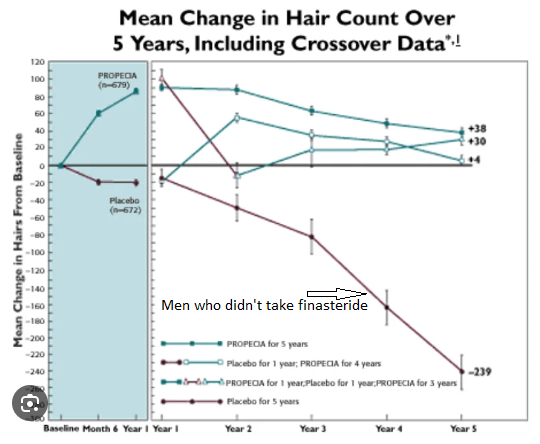
How Long Will it Take for Propecia to Stop the Shedding?

I am 22 years old and it appears that I have been losing more and more hair every day. If I go on the drug Propecia, how long will it take for the drug to stop the hair loss.

Responses from finasteride vary with the individual. I have seen some people stop their hair loss in a week from starting the medication, and other take a couple of months. You need to make the decision to continue using it from the time you start taking it. The full benefits could take up to a year.


Scientific Review of Adverse Effects (AE) of Finasteride and Dutasteride

Results Abstract:

Reported AEs with 5ARIs include sexual dysfunction, infertility, mood disorders, gynecomastia, high-grade prostate cancer, breast cancer, and cardiovascular morbidity/risk factors, although their true association, prevalence, causality, and clinical significance remain unclear. A pooled summary of all randomized, placebo-controlled trials evaluating 5ARIs (N = 62,827) revealed slightly increased rates over placebo for decreased libido (1.5%), erectile dysfunction (ED) (1.6%), ejaculatory dysfunction (EjD) (3.4%), and gynecomastia (1.3%). The limited data available on the impact of 5ARIs on mood disorders demonstrate statistically significant (although clinically minimal) differences in rates of depression and/or anxiety. Similarly, there are limited reports of reversible, diminished fertility among susceptible individuals. Post-marketing surveillance reports have questioned the actual prevalence of AEs associated with 5ARI use and suggest the possibility of persistent symptoms after drug discontinuation. Well-designed studies evaluating these reports are needed.

This is from a new review of the available data, published in Sexual Medical Reviews, titled “Side Effects of 5-Alpha Reductase Inhibitors: A Comprehensive Review“.

The report concluded: “5ARIs are associated with slightly increased rates of decreased libido, ED, EjD, gynecomastia, depression, and/or anxiety. Further studies directed at identifying prevalence rates and persistence of symptoms beyond drug discontinuation are required to assess causality.

Indeed, I look forward to reading more controlled studies that are necessary to determine the relationship between the cause and effect.


I See More Scabs 8 Days After My Hair Transplant

doctor, after my hair transplant i had shedding at the 3rd day after the operation. it comes with a hair and dark scab. is this the sign of losing graft? And on the 8th day i have a lot of scabs, more than first week. is this normal?

Grafts could come out at the 3rd day after your surgery, so if there are many then you could have a problem. I don’t know about your management of your recipient area after surgery. I generally recommend a specific washing procedure starting the next day after surgery and this keeps the eschars (scabs) down. Leave the eschars you have alone until they fall out, probably in a week or so.


My Hair Never Regrew After I Had Surgery at 2 Weeks Old

Hi, I am a 21 year old black female. When I was maybe 2weeks old I had surgery on my eyes and the doctor cut my hair on the sides to put an IV in. My hair never fully grew back. Their is a very little amount of hair on each side. I haven’t tried any meds or talk to any doctors yet. Will this ever grow completely?

With my inability to examine you, there is little I could say about the diagnosis. Generally, you can wait up to one year to see if hairs from trauma or surgery scar will ever grow back. In your case, it has been 21 years… so it would be highly unlikely for it to regrow now.


Do Single-Hair Grafts Have More Successful Growth?

Does the single hair graft and double hair graft affect the survival? which one has a more successful rate? Example: a doctor likes to claim that in eyebrow transplants you will get single hair grafts, which make eyebrow transplant more successful. Is that true?

If the surgeon knows what he/she is doing, it does not make a difference. In fact, if one divides a two-hair graft into two one-hair grafts, then there is a risk that the growth center, which is largely located just below the sebaceous gland, could be damaged resulting in the death of that particular hair. Making one-hair grafts out of two-hair follicular units is a special skill obtained with lots of experience.

Just to clarify as well: eyebrow transplants are not any more successful than a scalp hair transplant. So the argument of a one-hair graft being more successful, in my opinion, is not valid.


Stomach Pain and ED After Just a Month on Finasteride?

I am a 25 year old male who recently quit taking quartered Proscar pills after only 1 month on them. I began experiencing dull, persistent stomach pain and what I believe to be erectile dysfunction.

In the past 7 days, I have achieved only one full-on erection. I have achieved a couple relatively weak erections in the morning, but none strong enough for vaginal penetration. My girlfriend and I have attempted sex about 4 or 5 times, and only been successful the once.

Is it possible that I have ED after only a month on finasteride? Further, is it possible that now, 6 days after stopping, I am still experiencing sexual side effects? I am open to the possibility that the ED issues are psychological, but I am extremely worried about how to regain my sexual ability.

Thanks for your help.

You should be asking the doctor who prescribed the medication. I would need a more detailed history that would be obtained if I saw you. Erectile dysfunction can occur in as short a time as a week and stomach problems have been reported in the form of nausea, bloating, and excess intestinal gas.

The medication is ‘fixed’ in the tissues for up to 1-2 weeks although it is essentially our of your blood stream in 24 hours. I would expect that if your ED is caused by the medication, it should go away when you stop the medication, along with any other side effects you might experience. It could also be psychological.


I See Slight Regrowth in My Temples After 4 Months on Propecia and Minoxidil

After about 4 months on propecia and minoxidil I am experience a very slight start of regrowth in my temples! nothing major at all, but it would seem as if i will be able to sustain my current hair. In my temple region I have to types of hairs sprouting. One is thick and dark(like the rest of my hair)sprouting along the edges of my existing hair line. and the other is light and fine scattered through out where my hairline used to be. I was just wondering what I should expect, long term from these new hairs.

It takes a full 8 months or more to see real results from these medications. At 4 months, I would expect some small hairs from the minoxidil and minimal impact from Propecia. Be patient and wait at least 8 months, if not a year.


Should My First Hair Transplant Be FUE and Save the Strip Method for Later?

Excellent website. I have a question about FUE and strip surgery. I have read on forums and other hair loss websites that say its better to have a FUE transplant first if it is your first time getting a HT done rather then doing strip surgery. The strip method should be saved for any additional surgery that is needed or if you can in a second time. For some reason, they didn’t specify what type of surgery to get based on the size of the balding or number of grafts needed. I have read on this website that the larger the balding area the better it is to do strip because you can take out more grafts.

I am contemplating getting a surgery done, however, I am worried in the future my balding will progress and if I have to shave my hair in the future I don’t want a ’smiley face’ in the back of my head. Not to mention, if I need additional surgery and do choose to do strip again for some reason, I don’t want two smiley faces on the back of my head. I also wanted to add, I am 30 years old and have temple recession and a little thinning on my hairline and mid scalp. I know I will need a surgery in the future. I am on propecia so the crown has been holding well.

Take care.

For less extensive balding patterns in the Norwood class 3 range, either FUE or strip will get you where you want to be. If you start with FUE for a class 3, then you should finish with FUE. The choice here may be price of the procedure, as FUE is generally more expensive. The bond with the doctor you link with is also a factor. For the advanced balding patterns (class 5, 6, and 7), extensive harvesting with strip surgery is well understood with considerable experience in the hands of most surgeons. The FUE technique may not get you the yield in the 7,000+ graft range typically harvested with extensive restorations in some of the advanced balding patterns. I am assuming that the surgeon does not go outside the permanent zone for additional donor grafts.

For a graft yield in a Caucasian male, 5,000 - 8,000 follicular units may be an upper end for donor supply in FUE. The yield goes down in Asians and Africans, as the density is lower in these races. These numbers were calculated as follows:

The permanent zone contains 25% of the original hair. In Caucasians birth hair numbers are 50,000 follicular units, in Asians it is 40,000 follicular units, in Africans it is 30,000 follicular units. For FUE, the doctor can harvest no more than 2/3rd of the follicular units safely in the donor area in a Caucasian (that is 8,250 follicular units). If the density is higher than average for that particular individual, then the numbers can rise. For example, if a person is born with 60,000 follicular units (not uncommon in a Caucasian male with higher than normal density), then the surgeon may be able to harvest over 10,000 FUE grafts. That requires a high density birth hair presence which is present in less than half of Caucasians, rarely in Asians, and almost never in African hair type individuals.