Hair Loss Information at Balding Blog
 

About     Contact     Archives     Videos     Events     Hair Transplant

Your hair loss questions, answered daily.


Category Archive for Density


Density All Over the Scalp

First off, great site doc. Very helpful.

My question is about hair density and thickness. Say one buzzes their hair, should they expect the density and thickness of the hair to be the same over the whole head or are the backs and sides of the head thicker than the top of the scalp, generally?

Thanks, doc!

If you’re not balding, the density should be the same all over the head. If you are balding, density will vary with the pattern of genetic balding. Of course, there will be normal variations as well.


FUE and Scalp Laxity After 3 Strip Procedures

How many more grafts can you gain if you add FUE. Say i had three strips for 6000 grafts and i’m stripped out. how many on average more grafts can a person get with FUE? One doctor said between 1000 and 2000. Does this sound accurate? thank you

Your laxity might be good after three strip surgeries, but some patients might find the donor area to be tight. The higher the density at the time of the follicular unit extraction (FUE) harvest, the greater the yield will be. For an FUE, the remaining density will reflect your depletion of 6000 grafts from the original permanent zone. For those men with a high original density, there could be many more grafts available… and for those with an average or below average density, the different yield could be significant. If I examined you, I might be able to give you an educated guess, but there is no general answer to your question. A graft estimate of between 1000-2000 grafts is possible, but an examination is critical to the estimating process.


Density of Hair Transplants

Hello, I just had a wonderful procedure. Their offices were clean, procedures were excellent, and the staff was very accommodating. In 2002 I had 800 grafts done by another group in San Francisco and then again I just did 3500 grafts. The follicles were transplanted throughout my scalp approximately 25 FU/CM2. I have a very nice NW2 hairline. Also, I had a very high number of 4-hair grafts. Over 400 of them! They excised a strip of 3500 grafts and got 3703!!!

Do most of your patients get about 25FU/cm2 and are happy with it? I think it will be ok but just need reassurance.

A normal person will have 1250 hairs or 600 two-hair follicular units. When converted to cm/square, that would extrapolate to 100 follicular units per square cm. If you received 25 follicular units in 1 cm, that would suggest that in one procedure, the doctor returned 25% of your normal density on the transplanted area. This is often not really the case, as some areas will have higher densities put in and other areas lower densities. For a person with average weight hair, olive skin, and brown hair, 50% densities overall should be more than enough to produce a full appearance. If you had a high number of four-hair grafts, then that might mean that your overall densities are higher than average. I generally target 25% density return on the first session, but at times I will go higher or lower depending upon other factors.


Is My Density Above Average?

I’ve read that the average density of hair in the donor area is 2.0 hairs per square millimeter. I have a density of 2.2, which obviously is above average but how much? Is it slightly, moderate, or very high? Also, what’s the highest density you’ve ever seen on a patient?

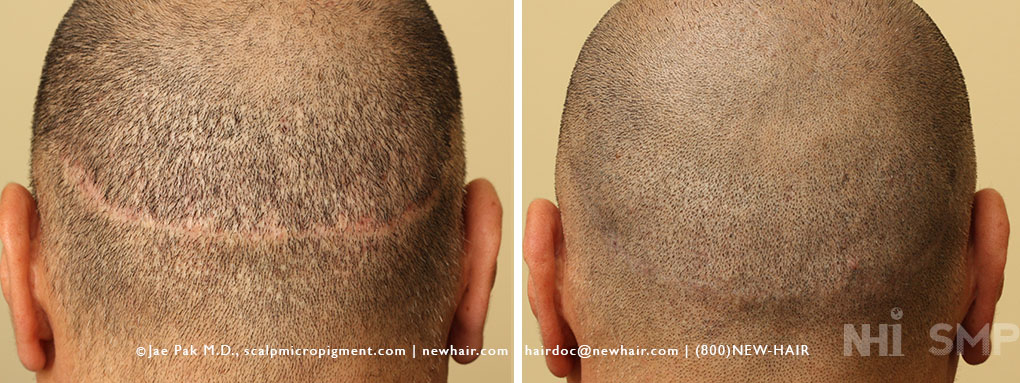
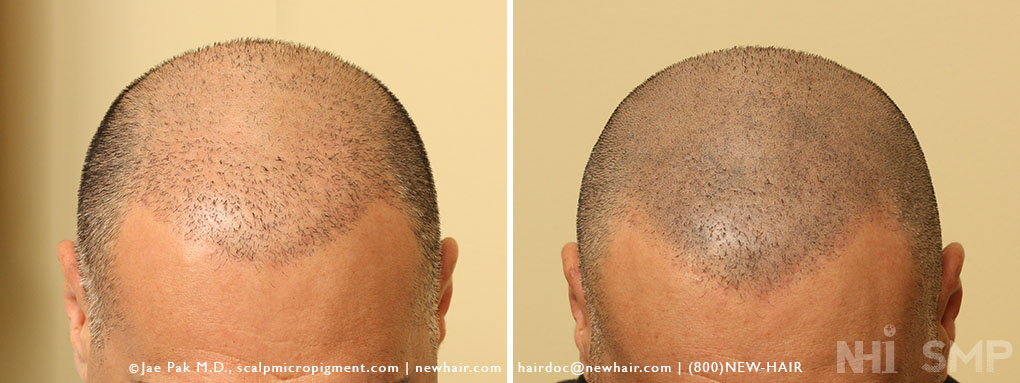
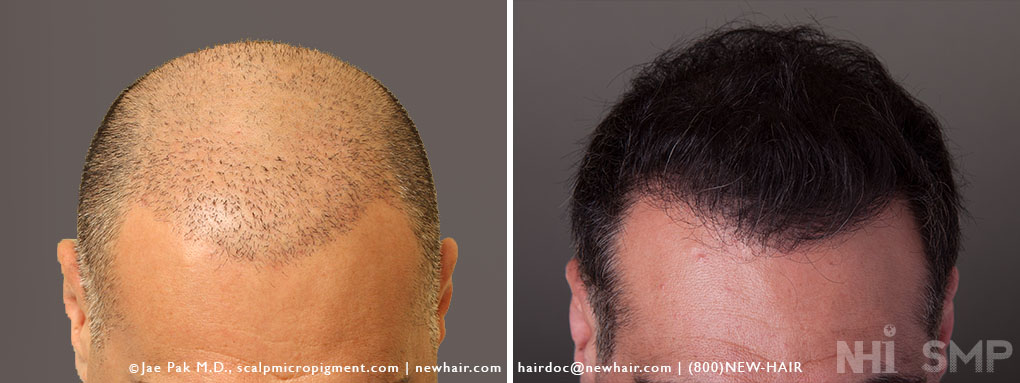
The difference between a 2 or 2.2 density could be the normal variation around your scalp. High densities have ranged from 2.6-4.0. Let’s take a look at a patient with a density of 4.0, who has now had nearly 9200 grafts transplanted. Before on the left, after on the right (obviously). Click the photos to enlarge.


To see more photos of this this patient’s remarkable transformation, click on Patient ZU.


Difference in Terms for Hair Loss

Hello Dr. Rassman, could you tell me what the difference between “thinning hair”, “Hair Loss”, “Miniaturization”, “Low and High Density”?

Also when people say poor nutrition, e.g. anorexia, zinc deficiency etc, causes thinned hair do they mean the shaft diameter of each hair decreases or hair falls out resulting in low density?

Thank You

Dictionary“Thinning hair” means a person is losing hair (usually hair that is miniaturized - i.e. thinning of the hair shaft) and does not have as much hair bulk as they once had. “Miniaturization” of hair means that a person’s hair shaft is not as thick in one area when compared to another area as it should be in its normal/healthy state. It is normal to have around 10% of miniaturized hairs for people who are not balding that may reflect what we call vellus hairs, present in every follicular unit.

“Density of hair” describes how many hairs are in a given area of scalp. For example an average Caucasian male can have a hair density of 2 hairs per square millimeter of scalp (which translated to about 100,000 hairs on a typical head size). If it is found that the density is 3 hairs per square millimeter, than the person is said to have a high hair density (born with about 150,000 hairs on the head). Hair density is variable and may depend on the ethnicity or race of a person as much as the inheritance patterns. Caucasians are born with an average of 100,000 hair on their heads, Asians about 80,000, and Africans about 60,000. These numbers are just averages and do not necessarily apply to what you may have on your head.


2 Weeks After Hair Transplant, The Density Looks Better on One Side!

I recently underwent a 1700 FUT procedure in the temples with a very respected surgeon. I followed all post-op instructions. A day after the surgery I noticed that the incisions on the left side temple looked closer than the right and I could see more hair coming from them. It is now 13 days post op and all scabs are gone. It seems that the hairs are more dense on the left side of my head than right.

My question is if the density of the hair I see that was transplanted is indicative of the final density I will see? If the right side looked less dense a day after surgery and looks less dense 13 days after surgery does that mean it will likely be less dense in the final result or can small hairs be transplanted below the skin hence not being seen until they grow out?

What you see is what you will probably get. Ask you doctor about it — maybe he did it intentionally as part of a plan he had for you.


7 Months After a Hair Transplant, the Density is Decreasing

Hallo,

I had an hair transplant on my temples about 7 months ago. After my transplant I had minimal and certainly not complete at all loss of transplanted small hair. After about 5 months I could see results which were incredibly positive and the hair in the transplanted areas was long and rather thick.

What I have experienced in the last 2 months has been a visible decrease in density of the transplanted hair. Is this possible? Also my hair loss in non transplanted areas has increased (I have been on propecia for 8 years)

Thanks a lot for your help

It is difficult for me to guess at what you are talking about. Existing original hair may continue to be lost to the balding process and even at 6 months shock loss can occur by accelerating the hair loss in the areas you are discussing. You doctor should have good photographs from just before your surgery to help you analyze what is actually happening. That is where you should get the answer to your question. Even if I saw you personally, I may not appreciate the changes you discussed above and the time line of those changes.


Transplanting Hair Between Existing Hairs

Dear Dr. Rassman,

How dense can hair transplant be done assuming that there are plenty of donor area with thick hair and the target area still has 50% density? Can hair transplant be done in-between existing hairs to make the hair thick again?

Tried Propecia but stopped after 2 days because of side effects. I appreciate your help on the matter.

You can transplant between existing hairs without difficulty, providing that the existing hairs are permanent and not miniaturized. I have seen patients receive very dense hair by transplanting between hairs that were previously transplanted.


Unfortunately, Some Hair Transplant Doctors Are Crooks

Last week, I met with two patients who came to me with thinning hair. One was 19 and the other was 22. The 19 year old had very early miniaturization, evident by the measurements that were taken of his scalp, and I built a Master Plan for him and advised him to go on Propecia. The 22 year old had clear thinning in the frontal 2 inches of his hairline with 40-50% miniaturization and a thin type hair shaft. The thin hair shaft made his miniaturization look worse than if his hair had been more coarse.

Both of these young men went to these doctors before they came to see me (and no, I won’t name names). In my opinion, both patients should not have hair transplants at this time; certainly the 19 year old is not a candidate at all and probably will not be for years, and the 22 year old may become a candidate if the Propecia does not stop or reverse his hair loss to meet his goals. However, the 22 year old might be able to avoid a hair transplant if the Propecia works well for him. The lack of ethics of the two doctors who viewed both men and gave them both recommendations of 3000 grafts each reflect the ’scum’ of the hair transplant industry. I know I’ve written on this topic a few times before, but it truly outrages me and demands this repetition. Performing surgery when it could be avoided with a simple daily medication shows that the doctors were chasing their patient’s pocketbooks, not pursuing their patients best interests. Fortunately, both patients liked my advice and will see me for a follow-up in a year or so. I am sure that they will get calls from these two doctors and/or their sales staffs and I strongly advised them to resist sales pressures to sell them what they do not need.

To make matters worse, in my normal examination I measured the hair density of the donor hair on these patients and found them both to be lower than average. That means that they might be limited as to what they can expect from a hair transplant when and if they balded. Both of the doctors that they met with just ran their hands over the patients’ scalp in the back of their heads and magically reported that they were unusually blessed with “lots of donor hair”. Neither of these doctors made a measurement of the donor density on either of these patients and as if by magic — *poof* — they had enough hair to meet the doctor’s income requirement. These scams are unfortunately common in this industry and I always warn patients that if the doctor does not precisely measure the donor density, they should run for the hills when told that their donor supply is good. Worst of all is the fact that if these men had undergone hair transplantation, their donor hair (which was limited in the first place) would be depleted, wasted, and worse yet, put in the wrong place. Over and over again I warn patients to do their diligence on the doctors they see and choose. This again, is a Buyer Beware market.


What’s the Highest Density Possible from a Hair Transplant?

Doctor,

Quick question: what is the most density one can achieve after a hair transplant? I’m a little more than 6.5 months after my first hair transplant (temple and front), and wondering if I’ll
ever be able to slick my hair back like I used to. I’m seeing growth, but the density surely isn’t near what I’ll need in order to reach my goal (at least right now it isn’t).

The issue is fullness, not density. At 6 months, I would not expect much fullness, but each successive month I would expect to see more and more. At 8 months you should see about 80% of what will eventually be there. The fullness may not directly relate to the density, as there are many variables (hair shaft thickness, hair character, hair and skin color, degree of baldness), so any absolute number without taking these other attributes into consideration does not mean much.