Hair Loss Information at Balding Blog
 

About     Contact     Archives     Videos     Events     Hair Transplant

Your hair loss questions, answered daily.

 
! NHI returns to Orange County!   Dr. Jae Pak is available for consultations in Newport Beach, CA. First consult is FREE! Call 800-639-4247.

Category Archive for Scarring


I Want Scar Revision and Then FUE to Eliminate My Scar Completely

Hi,

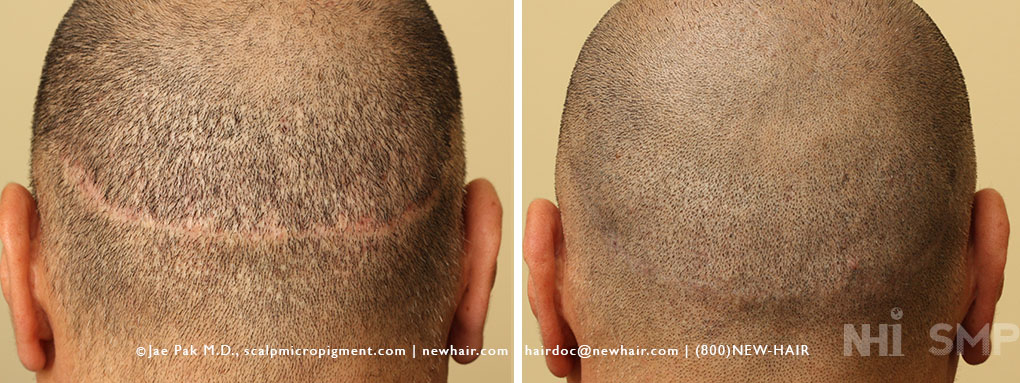
First of all I want to thank you for this informative blog. I have searched this wonderful blog and have found numerous postings relating scars and hair transplant. Here’s my case: I have what “they” call a coronal scar that runs from ear to ear. What I want is to completely cover the scar through a FUE procedure, but I want my scalp to be like how it first was, normal. My research has been conclusive and I first want to have a scar revision surgery to reduce the width of the scar, once that is done i want to follow some type of scar treatment to make the scar less obvious in color (seems like the scar gets pink/red after a scar revision surgery). Afterward get the FUE procedure and go from there. Is there any treatments that you would suggest?

I want the scar to be inconspicuous to the point to be able to cut the hair in the military/short hair style, because ultimatley i want to join the military as an officer.

Best Regards

Your plan is good, but it may not be realistic to have the scar completely hidden. Even if the hair in the scar is brought up to near normal density (which may take a few FUE procedures), there is often a color difference in the remaining scar, though of course it will be hidden with FUE grafts.

As you are local to my Los Angeles office, please arrange to see me so that I can ascertain a plan that matches yours. Any preparatory treatments can be assessed and recommended when you see me. You can call 800-NEW-HAIR (or 310-553-9113) to schedule a free consultation with myself or Dr Pak.


My 3 Year Old Has a Scar on Her Scalp with Hair Loss

Dear Sir,

I have read responses on your most helpful website. I hope you can help me.

My 3 year old daughter had a laceration to the back of her head 4 weeks ago. The cut was closed at hospital casualty with medical glue. The scar is about 4cm in length. The area around the scar is bald (say 2cm to 3cm either side).

Please could you advise if you think the hair will grow back on the area not scarred? I note with interest that you were in Vietnam. From what I have read the medical glues were first used there. Do you know if they led to such cases of baldness? If so, was it just short term? Also what can be done for hair restoration on the scar itself e.g. will hair grow back? Is it best left? can a transplant be done if necessary?.

This is really worrying me. Kind regards

Some hairs should grow back, but there may be an area where hair will not regrow. Medical glue does not cause scarring, but the lacerations will.

Hair transplantation can be done if necessary, but you should wait at least one year to allow hair to regrow to see what happens. Having a hair transplant at 4 years old is generally not advisable for fixing the scar, so perhaps you should wait until your daughter is older until she has a maturity level to undergo such a procedure. The best age will be determined between you and her doctor. Most girls under 8 years old do not really focus on small scars.


100% Donor Scar Elimination?

Dr. Rassman,

Do you think that 100% elimination of donor scars will be possible in the future? Technology is always improving and it seems like scars could be emliminated. Are there any other possibilities other than Juvista and Acell that are being researched? Thank you for all the helpful information.

Scarring happens as a result of all surgeries. There is no such thing as 100% elimination of a scar and treatments like Juvista and Acell will not dispose of scars entirely. The key to dealing with scars is to keep them very, very small. In the case of a donor scar, it can be as small as 1mm wide naturally in good healers, or reduced to that level on occasion. For bad healers, there really is no solution. By “bad healers” I mean those people who stretch their scars after the wound has healed.

Techniques such as the trichophytic closure repair of a wound in the donor area works well in many, but not all patients. For more info on the trichophytic closure technique, see here and here.


Notes from the ISHRS 2009 Conference, Part 2

ISHRS 2009I just got back from the 17th annual scientific ISHRS meeting (basically a hair transplant doctor’s convention), which went on from July 22-26. Lots of information was presented… lots of lectures, presentations, and discussions. This year’s meeting was in Amsterdam, so I had quite a long flight back to California when it was all over and I was able to do a write up on the plane of what I learned. I thought I’d share…

If you missed yesterday’s post, check out part 1 of my ISHRS meeting notes! Here’s part 2…


Surgical


Hair transplant failures:
Hair transplant failures are often due to undiagnosed scarring (cicatricial) alopecias, so the need to detect them is critically important in advance of the procedure. The skin is often white and shiny and their activity may be in spurts, active at some times and inactive at other times. In my opinion and from my experience, women suffer more undiagnosed scarring alopecias than men and reflecting abnormal patterns of balding may be a clue to their presence. The doctor usually makes the diagnosis when these abnormal balding patterns appear and then the doctor will take multiple skin biopsies in the identified areas. Biopsies are the traditional approach, but the tissues that are taken for biopsy must have some active disease going on to affirm a diagnosis. When the biopsy approach to diagnosis is made, they are made with sizable tools (usually a series of 4 mm punches along the edge of the abnormal balding pattern). Alternatively, test transplants (which are limited procedures) can be done to see if growth occurs at 6-8 months. I have been performing test transplants over the years in such suspicious cases, as this is a more certain way of making the anticipation of success or failure of a traditional hair transplant. Failures of transplants in patients with such scarring alopecias are common.

Hairline design:
This is an area that I find most interesting. My philosophy is very different than most other doctors in the field. I tend to place hairlines in the mature position while most other doctors place the hairlines higher with more recession. There is a belief by many doctors that eventually a traditional mature hairline normally found in a non-balding man will not look normal as a man ages, so the hairline designs offered by many of my colleagues leave portions of the Norwood Class 3 and 4 frontal pattern into the end design of the hairline. Most men, however, want the man that they see in the mirror to reflect the mature hairline, not an “older” looking hairline, so I recommend the mature hairline almost all of the time. This is easily seen at our monthly open house events or online in our Hairline Photo Gallery. As my design of a hairline differs from many of the designs of my colleagues, the art form of a hair transplant surgeon will be evident to all.

Graft trimming:
Graft trimming by the surgeon and his team seems to reflect the robustness of the hair growth. A study was performed by Dr. Michael Beehner, where he trimmed the grafts from chunky to very skinny. The grafts that were made very skinny did not grow as well as those grafts that were made more chunky with more fat surrounding the hair grafts. Dr. Beehner believes that making grafts very skinny seems to:

  1. Open them up to the damage from drying and being out of the body for any prolonged period.
  2. Critical elements of the growth centers where stem cells exist, may be trimmed away during graft preparation.

New Hair Institute has always produced chubby grafts for these obvious reasons giving us a good growth track record. There is a direct relationships between the size of the graft and the ability to make recipient sites and place them well. The need to match the graft thickness with the recipient site holes are critical for good graft stability and growth.

FUE:
Four devices were shown to improve the FUE (follicular unit extraction) process. Each claimed that their product was the only one that worked. Every one had a mechanical rotation associated with it one with vibration, others with partial twists of varying diseases. Costs for these devices run as little as $60/each for a disposable device, to as high as possibly $200,000 for robotic controlled FUE soon to be available on the market. Clearly when there are so many options offered, the suggestion is that none really work well. Time will tell which are the best instruments by next year’s ISHRS meeting in Boston.

Saturday morning held a series of sessions called “Breakfast with the Experts”. My session on FUE seemed to have the highest audience. The concerns by the participants were the wild and unsubstantiated claims in performing high numbers of FUEs in a single procedure and a very unrealistic view of damage to the FUE graft from transaction and stripping the grafts in the process of extracting the grafts.

Wound closures:
Would closures from strip surgery were discussed in great detail by many doctors, each promoting their own prejudices. There was clearly no technique that was better than others to prevent scarring. Suggestions on trichophytic closures were one of the few bright spots, but the differences in the techniques used by the various doctors, in my opinion, ranged from effective to completely ineffective. In other words, getting a trichophytic closure is no guarantee of a great result from the technique and a trichophytic closure in one doctor’s hands may be a radically different technique than the same procedure in another doctor’s hands. Results ranged anywhere between wonderful and a complete failure.


Will Hair Grow Back After My Car Accident?

i was in a car crash 4 months ago and got a bleed to the brain that needed to be operated on..im just wondering seen as im only 18 wil hair ever grow back on the scar if not is there anyding else i could do?

Incisions from brain surgery often produce scars because they widen slightly (about 1/4 inch on many people). If they are located in the hair baring scalp, then these scars are easily treated with hair transplants, quite successfully. The hair will not grow back on its own in the scar.


Experiencing Problems with Grafts Put Into a Scar

Dear Dr Rassman,
I recently had about 420 grafts put into a scar that was about 10mm wide and 100mmlong. Some of the hairs that were implanted in there (this is from about 4 months ago) are still in there. They haven’t grown, and are just sitting there..they are bent as well, where the growth has stopped. What does this mean?

Also, I keep getting scabs in the scar tissue where the hair was implanted. Would this be because my body is trying to remove those hairs that have not shed(but not growing), and does hair that grows in scar tissue cause the scar to scab, when breaking through the scar? Also, I was told i’d have to wait 18-24 months before most of the growth. Do you agree with this?

thank you

First and foremost, I would go back to the doctor who performed your surgery for a recheck. He/she should be able to answer your questions more specifically as it relates to a procedure they were a part of and know more about your overall health.

On average, it takes 6 to 12 months for hair to grow. Hair growth in scar tissue tends to be slightly slower than in non-scarred tissue, and in general, it is thought that hairs transplanted into scars do not grow as well as hair transplanted to normal scalp/skin. There is no study to prove one way or the other if that is true, though. In a few cases where I transplanted a small number of grafts into a scar and counted them at full growth, 100% of what I put in grew.


My Hairline Was Transplanted Too Straight

Hi Dr Rasman - many thanks for the very appreciated blog.

2 years ago I underwent an aggressive hairline FUE procedure - 3,000 grafts all in the hairline with temple closure.

I’ve recently started shaving my head and, despite the white-dotted donor area, I feel much better about myself. I’d love to continue shaving my head - the problem is the recipient area. My recipient hairs, though not particularly dense, are much thicker than the natural hair behind them and begin with a very sudden, ‘flat’ line. The texture of the skin is bumpy and *may* form a small ridge at the start of the hairline; it’s difficult to tell whether it’s scarring, or just hair follicles pushing up the skin.

If I were to remove the grafts, is there any hope of restoring a natural-looking, albeit bald area where my current transplanted hairline is? If so, what sort of treatments would you suggest?

Thanks again for the site

Oh wow! 3000 grafts to the hairline and temples does sound very aggressive, if not impossible from my personal experience. The bumpy skin texture you describe can be scarring from your surgery and if it is scarring there really is no treatment for it. I am not implying you had a bad surgery, but hair transplant surgery is not reversible. Hair transplant surgery is permanent and you need to have a good foundation and understanding of what you are getting yourself into, as well as the long term complication and issues (such as scarring and shaving) before you regret the decision.

There are doctors who do 3000 grafts routinely in a small area of the frontal line and I have seen the work. The hairlines I have seen are straight and many times I doubt that the patient actually got the 3000 grafts they paid for, which makes me question the integrity of the doctor. These hairlines can be repaired by creating a good transition zone in front of the harsh tight hairline, but that assumes that the hairline was not placed too low in the first place. Often in some of these patients the hairline is too low, making a good repair very difficult. Each case is different and I would love to see you either in consultation or good digital photographs of your frontal hairline.


Using Staples to Close Strip Surgery

Dear Dr. Rassman,

In one of your previous posts, you said that a scar from a strip surgery will be at about 80% of healing after 6 weeks. From that logic, I wonder if keeping the staples longer after a strip surgery (for 6-8 weeks, rather than the usual 14 days for instance) would help in getting a better scar…

I know that for practical and cosmetic reasons, keeping the staples longer can be problematic for many people, but in special cases where there is more tightness due to past surgeries (or a history of enlarged strip scar) wouldn’t this be a good solution to help getting a finer scar?

Or, would this in return create other problems such as:

1-skin growth around the staples?
2-Train marks?
3-Shock loss around the scar?

Thanks for your help

Scar formation and wound healing is not that simple. Aside from the technical aspect, everyone heals differently and scars differently. Leaving staples in for about 10 to 14 days is what we generally do. We leave the staples in for up to 21 days in some patients. Sometimes leaving staples in longer will cause the familiar Frankenstein or train track marks (as you state).

In the end there is no universal solution to closing a tight scalp. One solution does not fit all patients and it is up to the physician to address it on his/her individual basis. I know this may not be what you are looking for, but it points to the fact that sometimes there is just no specific answer. Leaving the staples in for 6-8 weeks will cause undo pain in most patients.


Shock Loss Around Donor Scar After a Hair Transplant?

Hi dr. rassman, thanks for the great blog

I have extensive shockloss around the scar from a recent strip hair surgery.

Do you think minoxidil would be good to help reverse the problem, and help the shocked hair to “fully” come back around the scar?

Loss of hair from around the scar is often the result of a surgical closure which was too tight. Sometimes the hair returns on its own and sometimes it simply doesn’t. Minoxidil won’t hurt, but probably will not help.

This has the potential to cause a very wide scar. Speak with your transplant surgeon about this problem and ask him/her if the closure was tight.


I Don’t Want Multiple Linear Scars from Multiple Hair Transplants

Hello Dr.Rassman,

Is it true that during the second transplant, the physician can cover the first scar that was caused by the first transplant? I would like to do a second procedure but do not want to have multiple scars as well as one BIG scar. Also, is it true that a scar from the transplant will be visible as the person ages and the hair in the back of the head gets thinner? One last question, can shock loss (loss of hair due to transplant) occur for already transplanted hair when a person undergoes a second transplant.

Thank You for your time

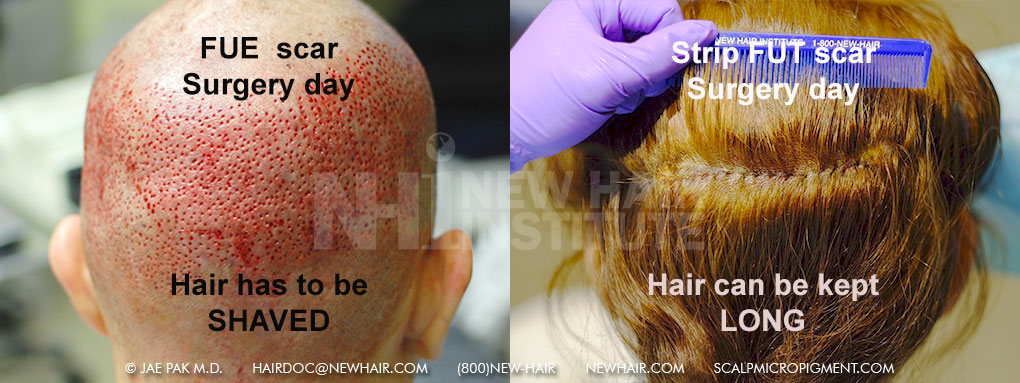
The state of the art today is to limit transplanted scars to just one, even with multiple surgeries. If, for any reason, the scar gets wider (5-10% of people) then a single scar can often be corrected in a special surgery that addresses the need for a scar revision. Some surgeons go into untouched areas of scalp and intentionally produce a ’step ladder’ set of scars which accomplishes two things: (1) a higher yield of hair, and (2) more dollars for the doctor’s pocket. I generally believe that step ladder scars produce a more unsightly look and can not be fixed easily while a single scar is easier to manage in the long term.

I personally had two hair transplant surgeries 16 years ago and you can barely see my scar and it has not changed (as typical) since the last surgery that had been done.

Your last question addressed shock loss in previously transplanted hair. It is very, very rare and if it should occur (less than .01% of cases) it always returns.